The dashboard's Advanced tab
June 2026
The dashboard — ⚡ LND Health — reads live from LND plus the operator database; it never writes. It's split into three tabs: Node (health: status, balances, watchtowers, backups, alerts), Flows (traffic: channels, sat flow, payments, routing, daily revenue) — both self-explanatory — and Advanced, the economics layer the pipeline actually acts on. That last one is worth a walkthrough.
Channel details — economics
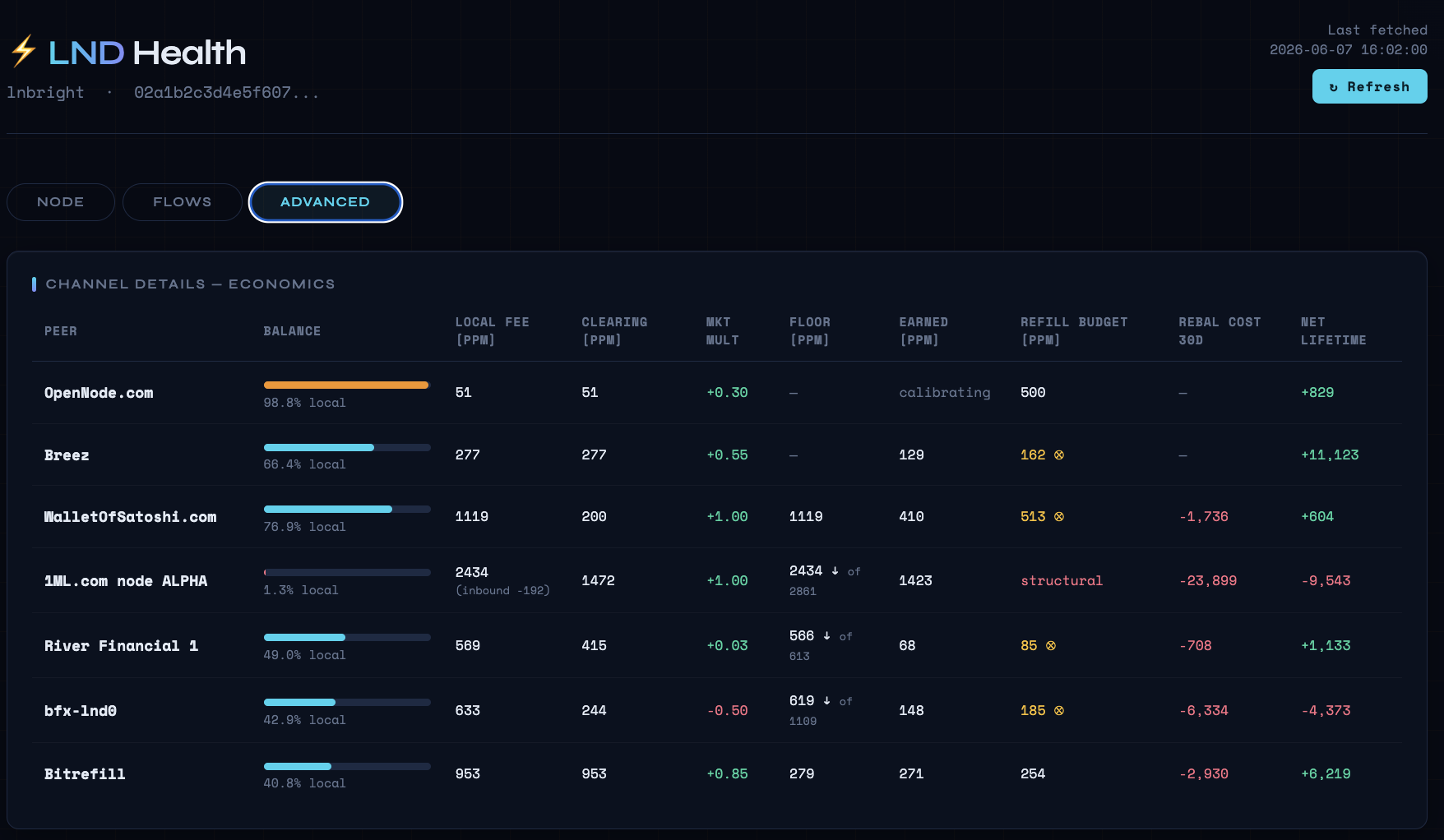
One row per channel, in fee-pipeline order — each column is one input to the decision the engine makes every cycle:
- Local Fee — the outbound ppm currently advertised; an active inbound discount shows underneath as
(inbound −N). - Clearing — where the fee would settle with no floor: sigmoid(local ratio) × market multiplier.
- Mkt Mult — the demand-driven multiplier, green when raising, red when discounting.
- Floor — the refill-cost floor (last refill × margin).
566 ↓ of 613means it's decaying toward a sellable price while the channel sits idle. - Earned — trailing revenue ÷ out-volume;
calibratingmeans too little volume yet to measure, so no cap applies. - Refill Budget — what the planner will pay to refill: plain = full escalation, yellow
⛒= profit-capped at earned × horizon, redstranded= refilling is a losing trade and it's parked as a capital decision. - Rebal Cost 30d / Net Lifetime — what keeping it filled cost lately, and whether the channel has paid for itself overall.
Read across a row and you can reconstruct the engine's whole verdict — e.g. a channel earning 68 ppm with a 566 floor and an 85-ppm capped budget is one that bought liquidity dear, sells it cheap, and is being repriced.
Forwarding failures — lost-revenue watch
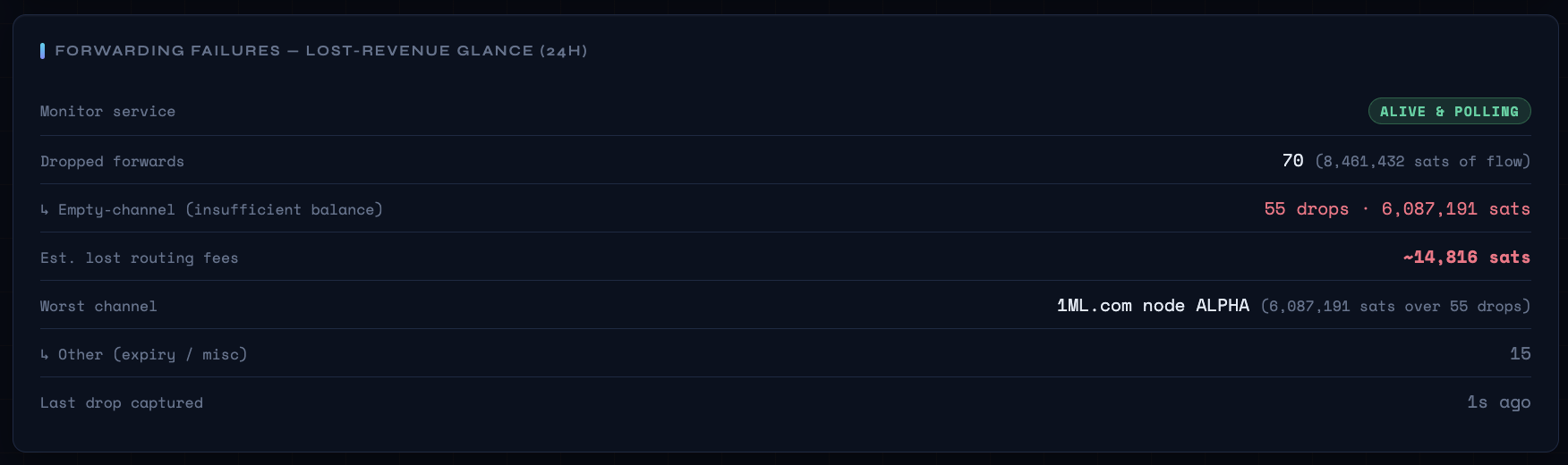
Routing attempts your node dropped in the last 24h — fees you could
have earned but didn't. These events are live-only (LND persists them
nowhere), so the Monitor service badge matters: if the
htlc_monitor daemon is down you're blind, not clean. It splits
empty-channel drops (recoverable — refill and the revenue
comes back) from fee-too-low and expiry causes, estimates the lost fees, and
names the worst channel.
Fee updates & rebalance history
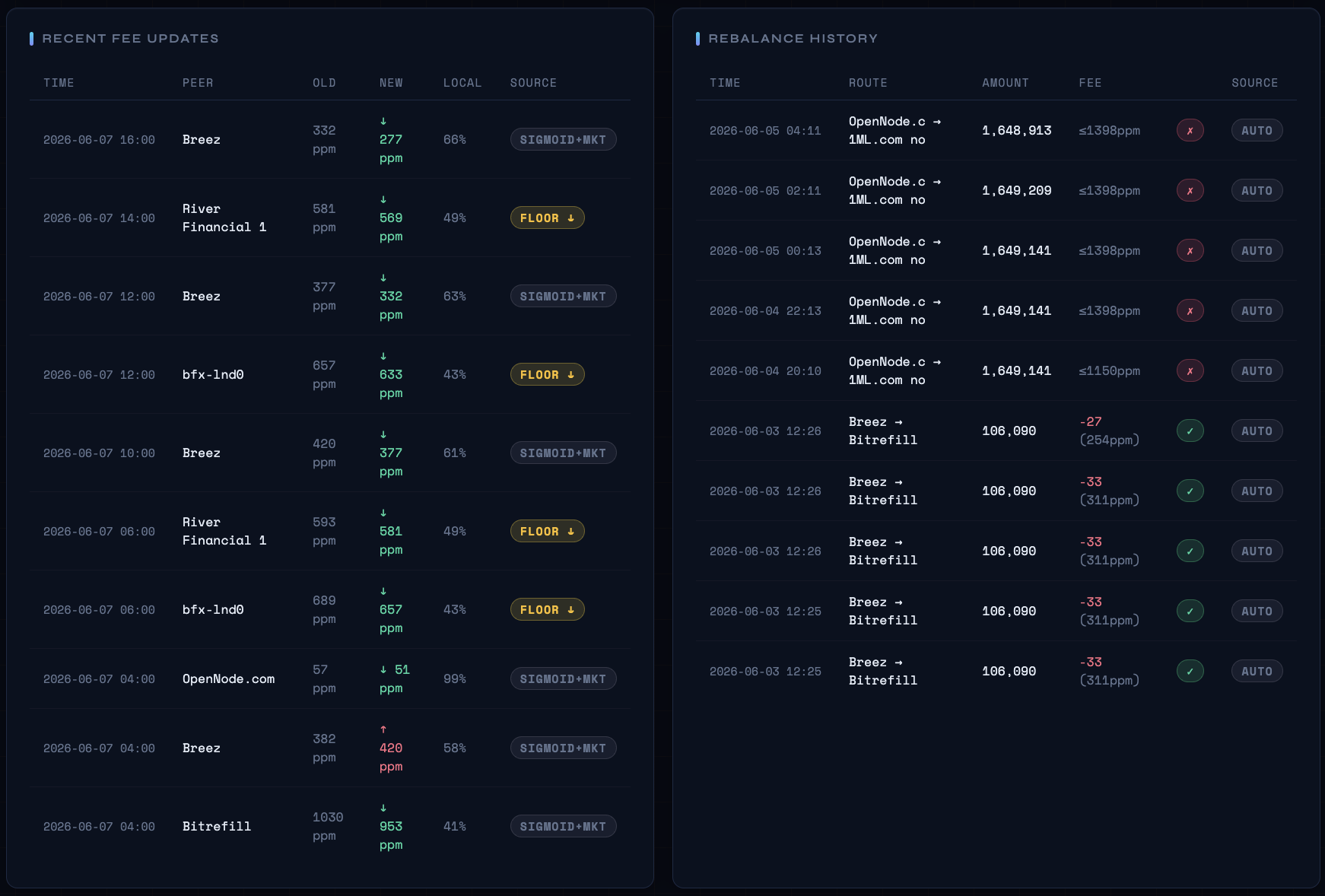
- Recent Fee Updates — every broadcast with old → new ppm, the local ratio at the time, and the layer that set it:
sigmoid+mkt,floor,floor ↓(decaying), or📌 pin. - Rebalance History — every attempt: route, amount, fee paid with effective ppm (or the
≤Nppmbudget tried on a failure), ✓/✗, andautovsmanual. A mutedskippedbadge (rather than a red ✗) marks a QueryRoutes early-out — a dry-run found no route within the affordable ceiling, so no payment was attempted — so it isn't miscounted as a tried-and-failed rebalance.